B2B Prospecting for Hotels: How to Find Companies That Actually Need Rooms
Learn a practical B2B prospecting process for hotels, including who to target, what signals to use, who to contact, and how to follow up.
Most hotel prospecting fails before the first email is sent. The problem is not the copy. It is the list.
If a hotel contacts random companies because they happen to exist in the same city, the outreach will feel random too. Strong B2B prospecting for hotels starts by identifying organizations with a credible reason to create overnight stays near the property.
The job is not to build the largest database. It is to build the most commercially relevant one.
Start with demand, not company size
A large employer can be a poor hotel prospect if nearly everybody works locally. A smaller contractor can be excellent if it moves technicians between projects every week. The question is not "How big is this company?" It is "What could make this company put someone in a hotel near us?"
This shift immediately improves prospect quality because the hotel looks for travel-producing behavior rather than impressive logos.
10 types of local prospects worth investigating
Construction and infrastructure contractors
Hospitals and healthcare organizations
Manufacturing and industrial companies
Consulting, engineering, and professional-services firms
Logistics, transport, and aviation companies
Universities, research institutes, and training centres
Recruitment-heavy employers
Event venues and production companies
Regional headquarters and branch networks
Public-sector projects and suppliers
1. Construction and infrastructure contractors
Projects bring non-local workers, engineers, subcontractors, supervisors, and specialists. Look for active sites, awarded contracts, and project timelines.
2. Hospitals and healthcare organizations
Hospitals and clinics may bring in locum doctors, specialists, visiting staff, interview candidates, trainers, and vendor teams. Early breakfast, quiet rooms, and proximity can matter more than lifestyle positioning.
3. Manufacturing and industrial companies
Plants receive auditors, commissioning teams, maintenance crews, suppliers, engineers, and visiting management. Shutdowns, installations, and expansion projects are useful triggers.
4. Consulting, engineering, and professional-services firms
Client work can bring project teams into a city repeatedly. These accounts may value predictable booking, flexible cancellation, strong Wi-Fi, breakfast, and a convenient commute.
5. Logistics, transport, and aviation companies
Crew movements, driver accommodation, training, disruptions, and route operations can create recurring stays. The operational requirements can be specific, so qualification matters.
6. Universities, research institutes, and training centres
Visiting lecturers, researchers, examiners, candidates, external speakers, and short courses can all generate room nights.
7. Recruitment-heavy employers
Companies hiring nationally or internationally may bring candidates and new employees into the area. Relocation and onboarding can create additional stay patterns.
8. Event venues and production companies
Events create speakers, performers, production crews, exhibitors, technicians, and organizers. A venue may also become a referral partner even if it does not book all rooms directly.
9. Regional headquarters and branch networks
Organizations with distributed teams can generate internal meetings, training, leadership visits, and employee travel between offices.
10. Public-sector projects and suppliers
Government projects, municipal works, inspections, consultants, and suppliers can create demand. Sales teams should always respect applicable procurement and public-sector rules.
Use buying signals to prioritize the list
Once you have categories, add signals. Signals turn a static directory into a prospecting queue. Examples include a new office, construction award, expansion announcement, major hiring, new contract, plant maintenance, event calendar, merger integration, training programme, or a project with a defined start date.
A hotel can also use operational fit as a signal. If a company is six minutes away, has poor public transport access, and runs early shifts, parking and breakfast from 05:30 may be a strong reason to contact them.
Find the role closest to the travel problem
The best contact is often the person who feels the accommodation problem. For a construction project that may be the project administrator or site manager. For a regional office it may be an office manager or executive assistant. For recruitment it may be HR. For crews it may be operations.
Try to map the account rather than finding one generic email. Two or three relevant contacts create a more resilient relationship and make it easier to route the offer internally.
Write outreach around the reason, not the hotel
Most hotel sales emails start with the property: number of rooms, renovated lobby, breakfast buffet, meeting rooms. Those details matter later. The first message should start with why the recipient might care.
A useful structure is: observation, relevance, simple offer, low-friction question. For example: "I noticed your team is working on the new distribution project near Airport Road. We are seven minutes from the site and can set up a fixed project rate with parking and early breakfast. Is accommodation handled by you or someone else on the project?"
That message is short, specific, and easy to redirect.
Build a prospecting score
Hotels can keep scoring simple. Give points for distance, likely travel frequency, active trigger, company size, fit with your need periods, and quality of the contact data. Subtract points for obvious mismatch, such as a location on the wrong side of a major commute barrier.
The score is not meant to predict perfectly. It is meant to stop the team from spending equal time on a low-potential local shop and a high-potential project account.
The weekly prospecting workflow
A practical routine is to discover new accounts once or twice per week, score and shortlist them, enrich relevant contacts, send a small number of personalized messages each day, and process follow-ups every morning. New prospects should continuously enter the top of the funnel while qualified accounts move toward rates and bookings.
The hotel should review which prospect categories convert best. If contractors produce three times more active accounts than generic offices, the next month's prospecting effort should reflect that learning.
How Room Radius changes the starting point
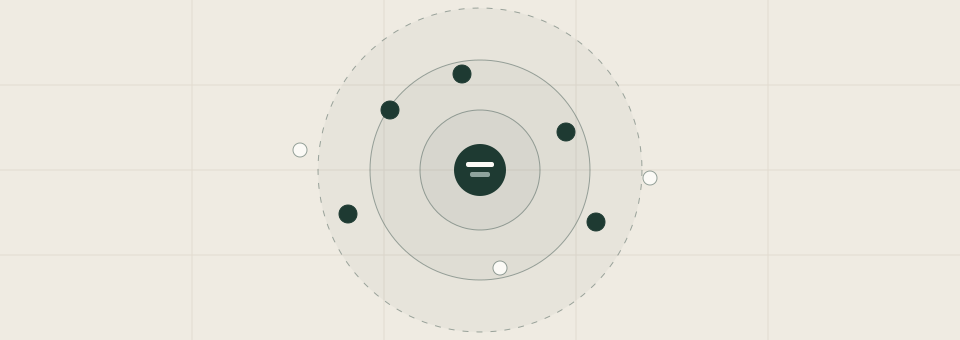
Room Radius is designed to remove the blank-page problem from hotel sales. Instead of asking a salesperson to manually search the local market, the system starts with companies around the hotel and helps turn them into structured prospects.
That makes prospecting more systematic: geography, opportunity, contact, message, follow-up, pipeline, then room-night production.
Frequently asked questions
What is B2B prospecting for hotels?
It is the process of finding organizations that may need accommodation, identifying the right contacts, reaching out with a relevant offer, and moving interested companies into a hotel sales pipeline.
Where can hotels find corporate leads?
Useful sources include local business databases, company websites, maps, project announcements, industrial parks, event calendars, LinkedIn, recruitment activity, local news, and purpose-built prospecting platforms.
Who are the best corporate prospects for a hotel?
The best prospects are organizations that create repeat or project-based overnight travel and fit the hotel's location, rate level, facilities, and need periods. Contractors, healthcare, industrial, consulting, logistics, training, and regional-office accounts are common examples.
How often should hotels prospect?
Prospecting works best as a recurring sales habit. A small amount of new account discovery and outreach every week is usually more sustainable than occasional large campaigns.
Room Radius
Find companies that have a reason to book your location. Room Radius turns the area around your hotel into a prioritized B2B prospecting list with contacts and follow-up built in.
Where this fits with Room Radius
Room Radius does the part of this that takes the most time: it finds the companies around your hotel, works out who to contact at each one, and keeps the follow-ups moving. See how it works, or work out what it could be worth using your own occupancy and rate.