Hotel Sales Prospecting: Build a Weekly System That Produces Corporate Accounts
Build a hotel sales prospecting system that turns local companies into conversations, corporate rates, and repeat room-night accounts.
Hotel sales prospecting often happens in bursts. Occupancy looks soft, somebody downloads a list, the team sends a batch of emails, and then operations take over again. Three weeks later, the pipeline is empty.
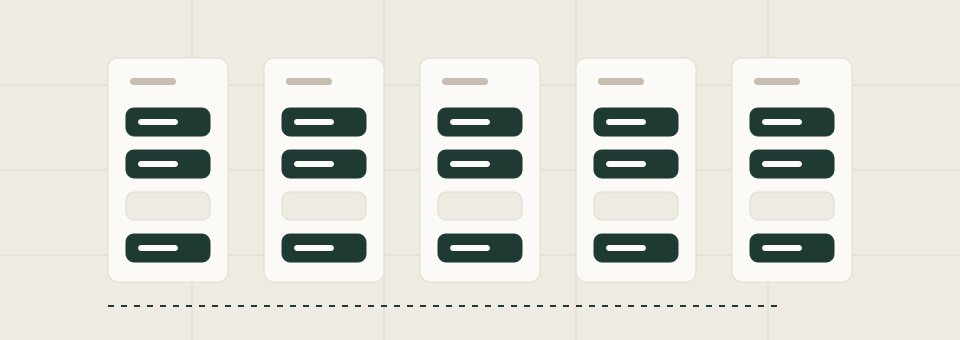
The better model is boring in the best possible way: a small amount of focused prospecting every week, a visible follow-up queue every day, and a monthly review of which accounts actually produced room nights.
A repeatable system beats an occasional sales push because corporate accounts are built through timing and follow-up.
Define the sales problem first
Do not start with "we need more corporate clients." Define the need period. Perhaps the hotel needs Sunday through Thursday occupancy in January to March. Perhaps it has weekend strength but weak Mondays. Perhaps a new room block has created shoulder-season capacity.
This matters because the best prospect is the company whose travel pattern fits the hotel's problem. Sales should support revenue strategy.
Build a target-account profile
A target-account profile describes the types of companies most likely to produce valuable room nights. Include distance from the hotel, industry, travel trigger, estimated workforce or project size, typical length of stay, expected day-of-week pattern, parking or transport needs, and rate fit.
You can create several profiles. A city-centre hotel might target consultancies, legal firms, regional headquarters, universities, and event organizers. A roadside property might prioritize construction, utilities, field service, logistics, and infrastructure crews.
Set a weekly activity target you can actually sustain
The right volume depends on the team. A smaller hotel might add 25 qualified accounts per week and send 10 highly relevant first contacts per day. A dedicated sales team can do more. The important word is qualified.
If activity targets are too large, quality collapses and the CRM fills with noise. If they are too small, the pipeline never compounds. Start with a sustainable baseline and measure results.
Use a four-touch outreach sequence
A simple sequence can outperform improvisation because it keeps the message short and gives the prospect several chances to respond.
Touch one: lead with the reason for contact and proximity. Touch two: add a useful operational benefit. Touch three: make the offer concrete, such as a project or preferred-company rate. Touch four: close the loop politely and make it easy to reconnect later.
The sequence should stop when the person replies. Sales automation should support human conversation, not continue sending messages after the prospect has engaged.
Make every email answer "why us, why now?"
A nearby hotel is not automatically relevant. Connect the property to the company's situation. "We are close" becomes stronger when it is "we are six minutes from the site." "We serve breakfast" becomes stronger when it is "breakfast starts before your team's shift."
Personalization does not require a paragraph about the recipient's career. It requires one accurate reason the hotel could solve a travel problem.
Route replies into clear next steps
Not every positive reply means the same thing. Use simple dispositions: not responsible, no current need, future need, send information, rate request, call requested, active negotiation, won, and not a fit.
Each disposition should trigger the next action. If the recipient is not responsible, ask for the right person. If the need starts in October, schedule a follow-up in September. If they request a rate, send it fast and set a reminder.
Keep the pipeline small enough to understand
A pipeline is valuable only when its stages mean something. One practical structure is New, Contacted, Engaged, Qualified, Rate Sent, Negotiation, Won, and Dormant.
Do not leave hundreds of dead accounts in "Contacted" forever. Use rules for when an account becomes dormant and when it should re-enter a sequence. Clean data creates trustworthy reporting.
Measure conversion from company to room night
The full funnel can be measured as: companies identified, contacts found, first messages sent, replies, qualified opportunities, rates sent, accounts won, accounts activated, room nights, and revenue.
This lets the hotel diagnose the real bottleneck. Low reply rate may mean poor targeting or messaging. High reply rate but few rates sent may mean weak qualification. Many signed rates but few room nights may mean onboarding, pricing, location, or booking-friction problems.
Use account production to improve prospecting
Every active account is training data for the sales strategy. If the hotel discovers that engineering firms within eight minutes produce long midweek stays, find more companies with similar characteristics. If generic office prospects almost never convert, reduce effort there.
This creates a feedback loop: prospect, sell, measure, learn, prospect better.
Where automation helps and where it should stop
Automation is excellent for repetitive work: finding data, creating lists, logging activity, reminding the team, scheduling follow-ups, and reporting. It is less useful when it removes relevance or judgment.
The hotel should automate the mechanics while keeping the commercial decision human: Is this a good account? What is the travel reason? What should we offer? Is the rate worth it? How do we strengthen the relationship?
Room Radius as the prospecting layer
Room Radius is built to make this weekly rhythm easier. The platform can start with businesses around the property, surface likely opportunities, help find the people who book, and organize outreach and follow-up inside a hotel-specific pipeline.
The result is a sales process that can be repeated regardless of who is on shift or whether the general manager remembers the company they spoke to three months ago.
Frequently asked questions
What is hotel sales prospecting?
Hotel sales prospecting is the process of identifying potential accounts, finding relevant decision-makers, contacting them, qualifying travel demand, and moving good opportunities toward negotiated rates and bookings.
How many prospecting emails should a hotel send?
There is no universal number. A sustainable volume of well-targeted messages is usually more useful than a large blast. Start with a daily target the team can personalize and follow up properly, then adjust based on conversion data.
How many follow-ups should hotel sales send?
A short multi-touch sequence is common, but quality matters more than a fixed number. Each follow-up should add context or value, stop when the prospect responds, and respect applicable email and privacy rules.
What should hotels track in a sales pipeline?
Track accounts identified, contacts reached, replies, qualified opportunities, rate proposals, wins, activated accounts, room nights, revenue, last activity, and next action.
Room Radius
Make corporate sales a weekly system instead of an occasional campaign. Room Radius helps your hotel discover local prospects, find the right contacts, follow up consistently, and turn activity into a measurable pipeline.
Where this fits with Room Radius
Room Radius does the part of this that takes the most time: it finds the companies around your hotel, works out who to contact at each one, and keeps the follow-ups moving. See how it works, or work out what it could be worth using your own occupancy and rate.